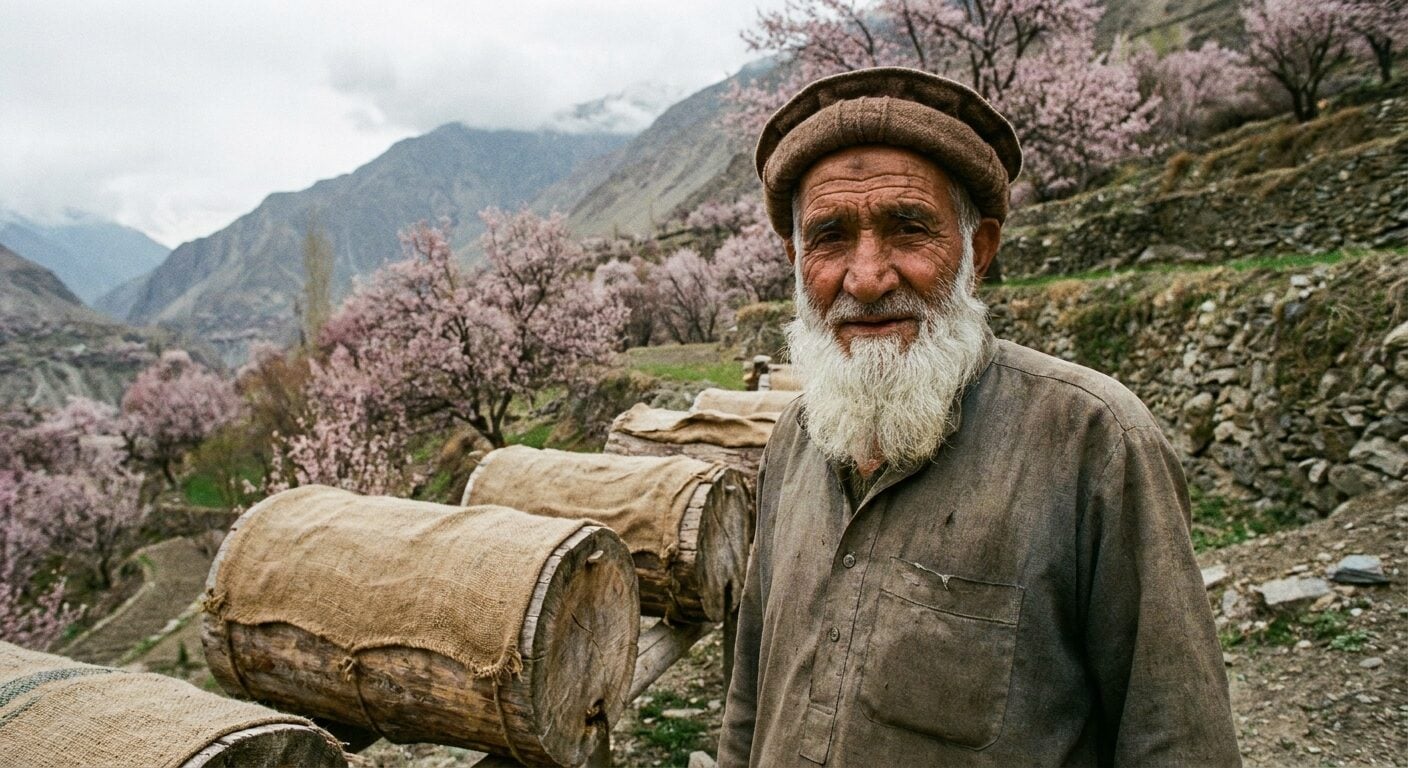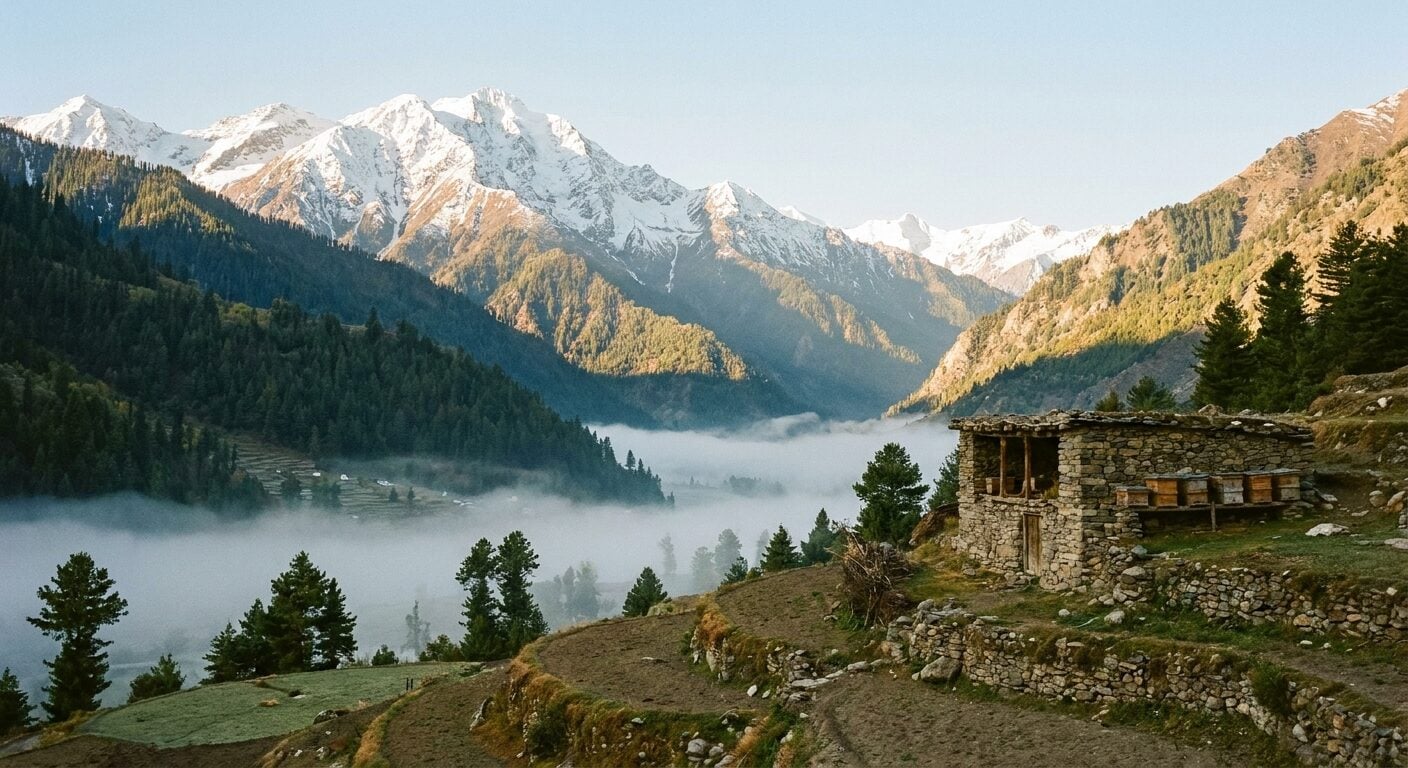
The Chitral valley beneath Hindu Kush ridgelines at first light

EST. 1987 · CHITRAL

The mountain
decides.

In the high valleys of Chitral, between three and four thousand metres, wild colonies work a bloom that lasts weeks, not months. We take only what the hive can spare, we never heat it, and we never blend two valleys together. What reaches your table is a single place, a single season, sealed under wax and numbered by hand.

35.8525° N · 71.7864° E2,850–3,400 mraw · unheated · single-origin
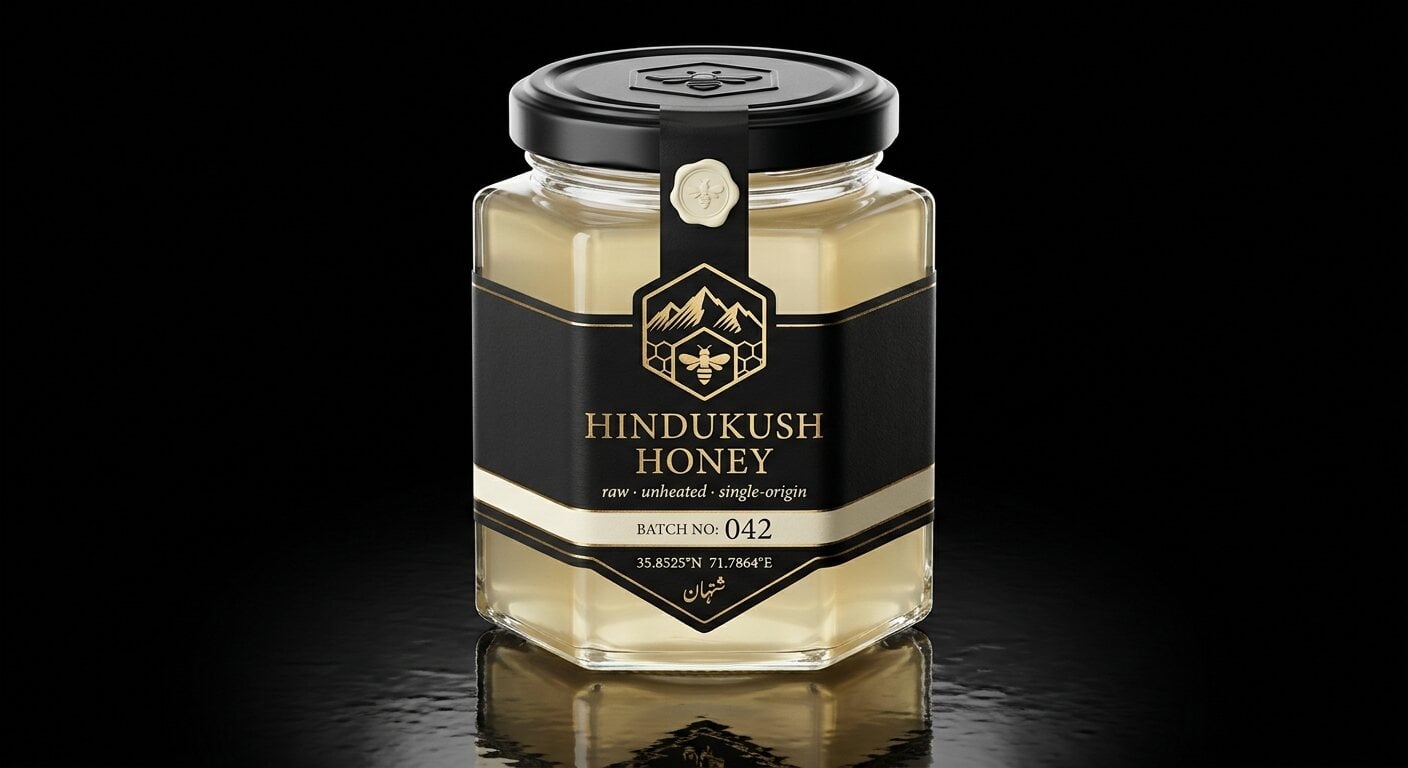
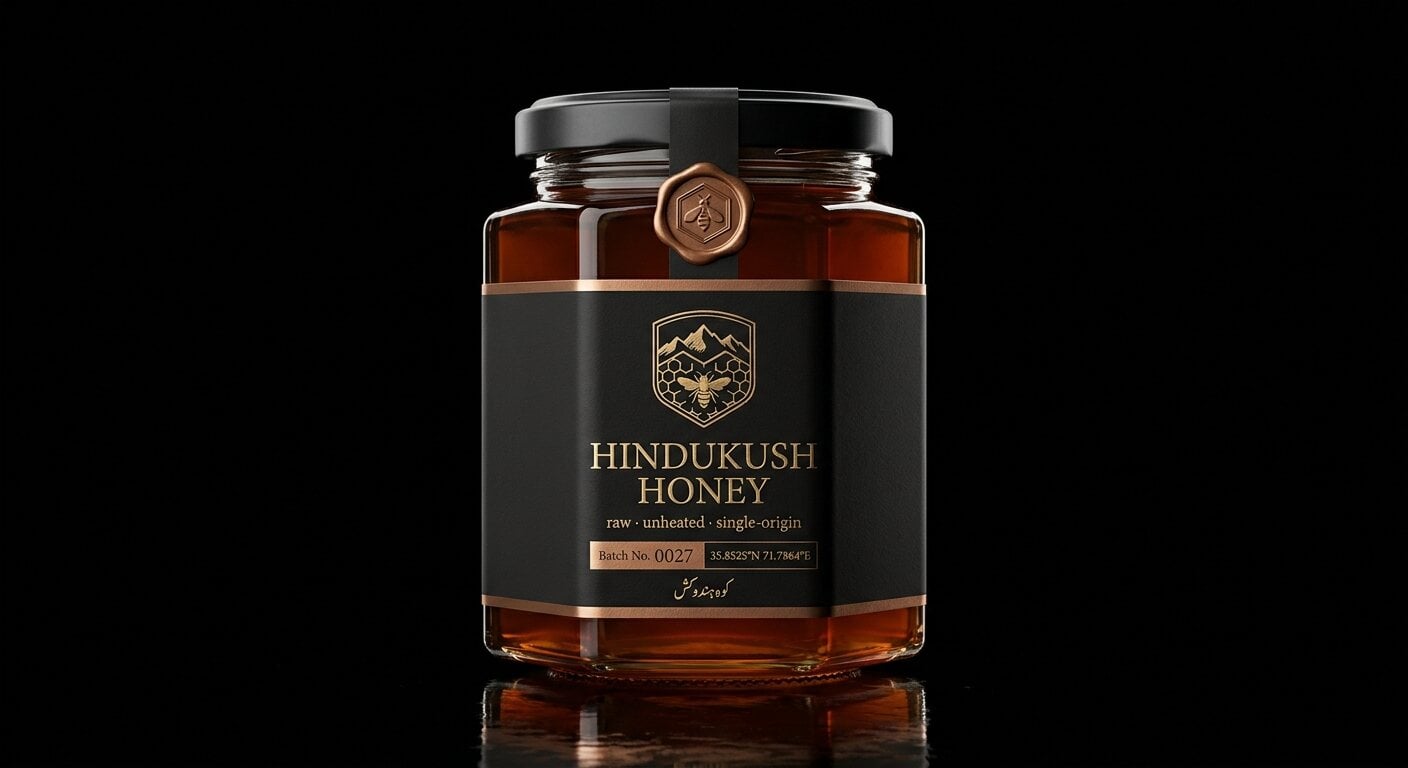
A wax-sealed hexagonal jar of Hindukush Honey, black label with gold foil, glowing against dusk ridgelines

HK-24-ZT-041

hand numbered

No. 01Zaytoon · HK-24-ZT-041

Scroll
raw · unheated · single-origin35.8525° N · 71.7864° Ealtitude 2,850–3,400 mhand-numbered batchesmelissopalynology testedsealed in beeswaxraw · unheated · single-origin35.8525° N · 71.7864° Ealtitude 2,850–3,400 mhand-numbered batchesmelissopalynology testedsealed in beeswaxraw · unheated · single-origin35.8525° N · 71.7864° Ealtitude 2,850–3,400 mhand-numbered batchesmelissopalynology testedsealed in beeswaxraw · unheated · single-origin35.8525° N · 71.7864° Ealtitude 2,850–3,400 mhand-numbered batchesmelissopalynology testedsealed in beeswaxraw · unheated · single-origin35.8525° N · 71.7864° Ealtitude 2,850–3,400 mhand-numbered batchesmelissopalynology testedsealed in beeswaxraw · unheated · single-origin35.8525° N · 71.7864° Ealtitude 2,850–3,400 mhand-numbered batchesmelissopalynology testedsealed in beeswax

01 — Origin & Terroir

One valley.
One season.

Chitral sits where the Hindu Kush shouldering into the Karakoram makes its own weather. The bloom is short and violent — wild olive in April, black locust in May, thyme when the plateau finally thaws in July. A colony here gathers in weeks what lowland bees gather in months.

We place each apiary by hand, above the irrigation line where nothing is sprayed because nothing is farmed. The coordinates are on every label because the coordinates are the whole point.

Grid reference
35.8525° N · 71.7864° E
Apiary band
2,850–3,400 m
Bloom window
April — August
Colonies
≈ 240, never moved
Terraced hillsides of Chitral with wooden apiary boxes under snow ridgelines

Fig. 01 — Drosh valley apiary band, 2,850 m. April bloom, wild olive.

02 — Honey Varieties

An index of
the bloom.

Five valleys, five nectar sources, five distinct honeys. None are blended; none are flavoured. Read them like a wine list from a mountain.

Zaytoon

Olea cuspidata — wild olive
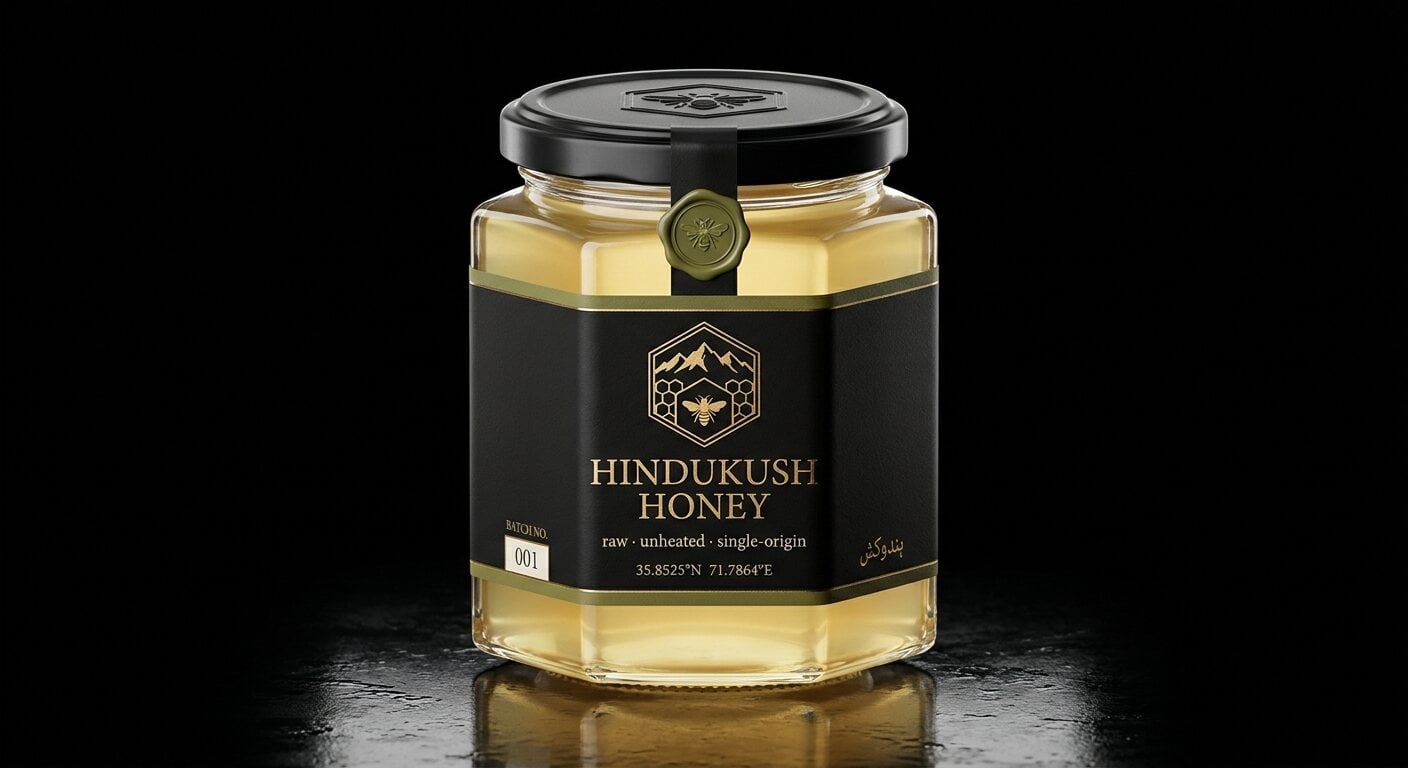
Zaytoon — hexagonal jar of Hindukush Honey with black and gold foil label
Origin valley
Drosh Valley
Altitude
2,850 m
Bloom
Late April — early June
Colour
Dark amber, olive cast

Viscosity

Slow. Holds a spoon's edge.

Tasting notes

  • black fig
  • olive leaf
  • warm tobacco
  • long pepper finish

Best used

Over aged cheese, torn sourdough, or taken alone after dark.

Current batch

HK-24-ZT-041
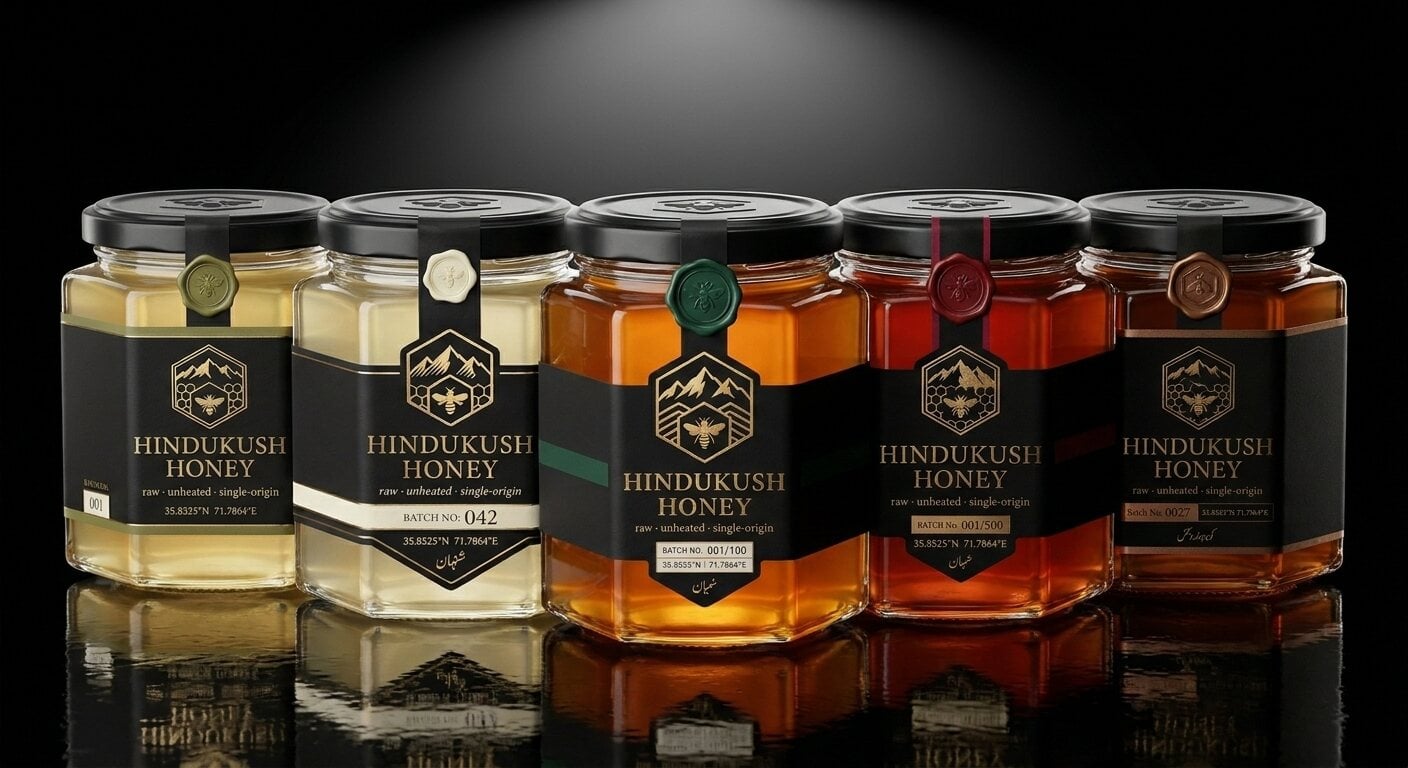
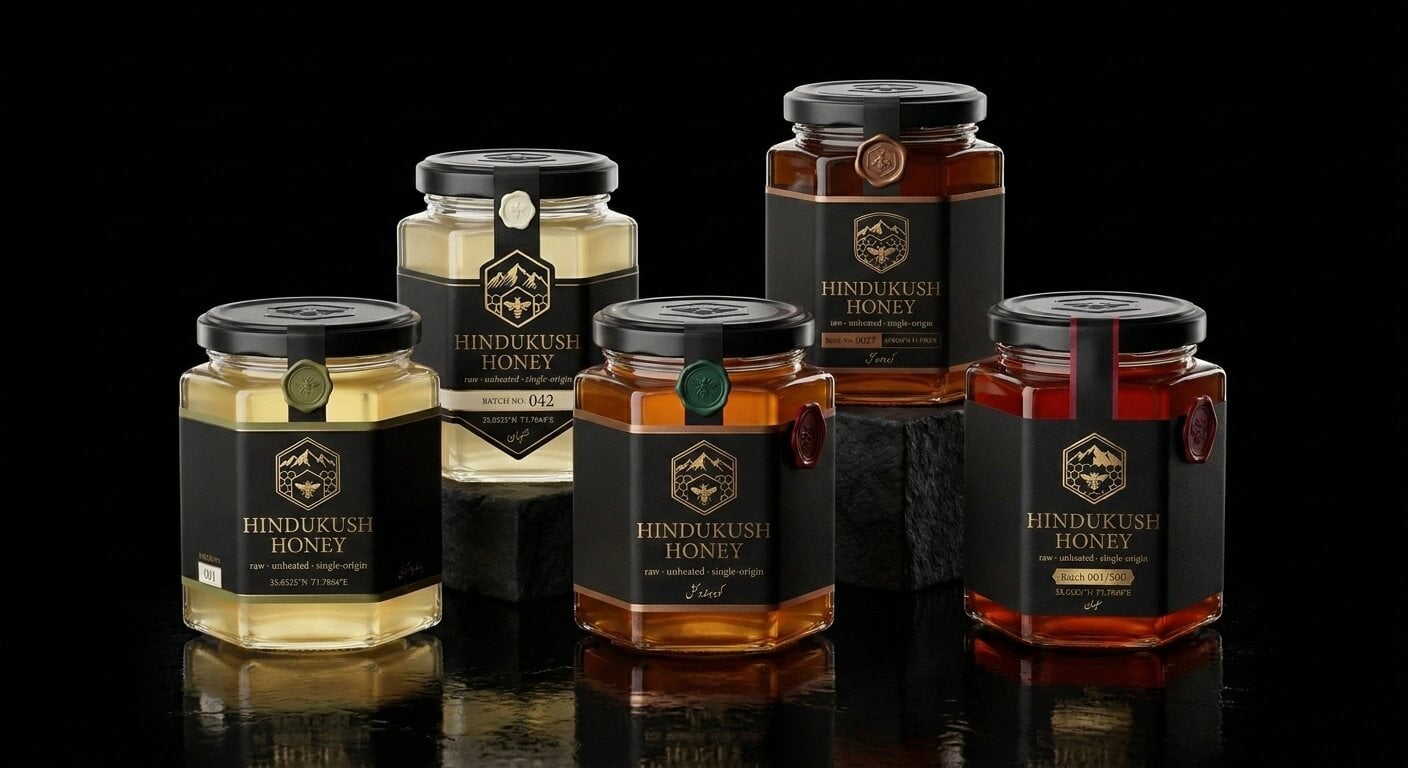
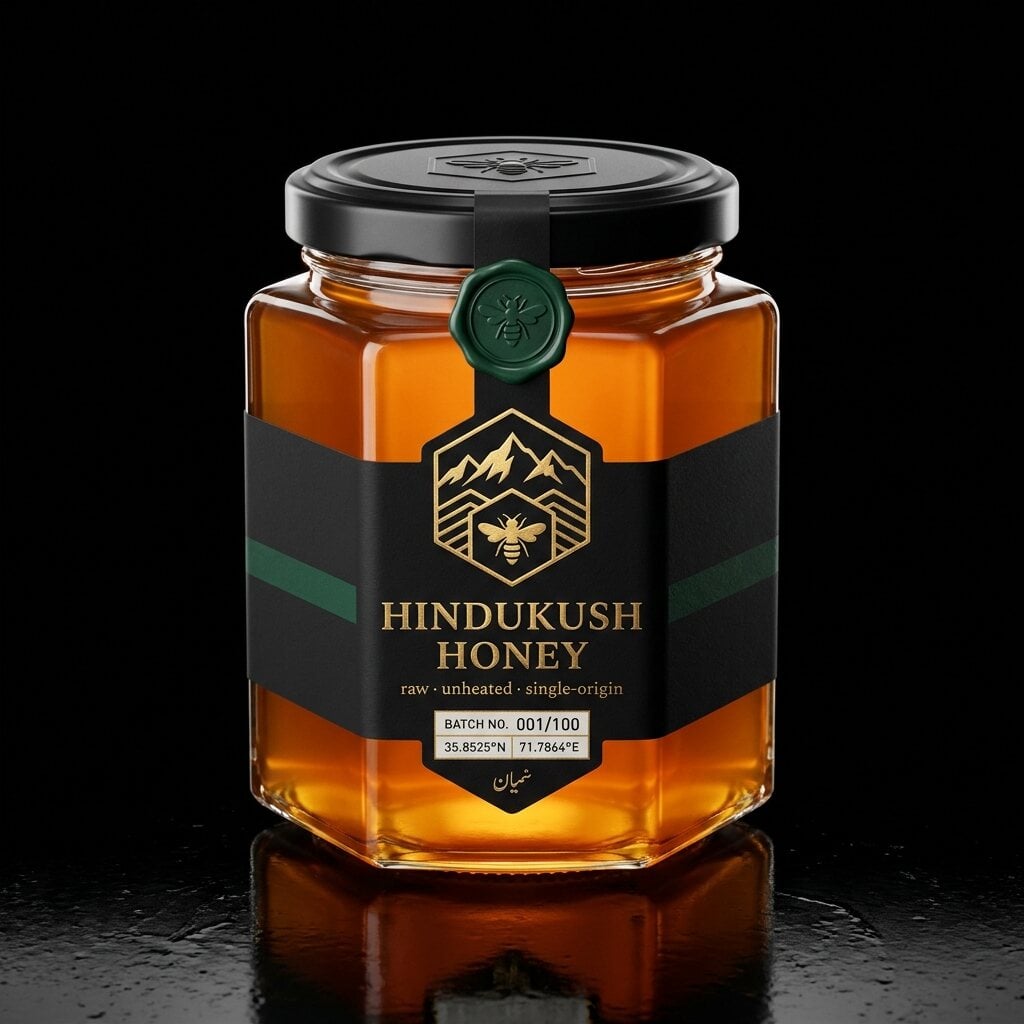
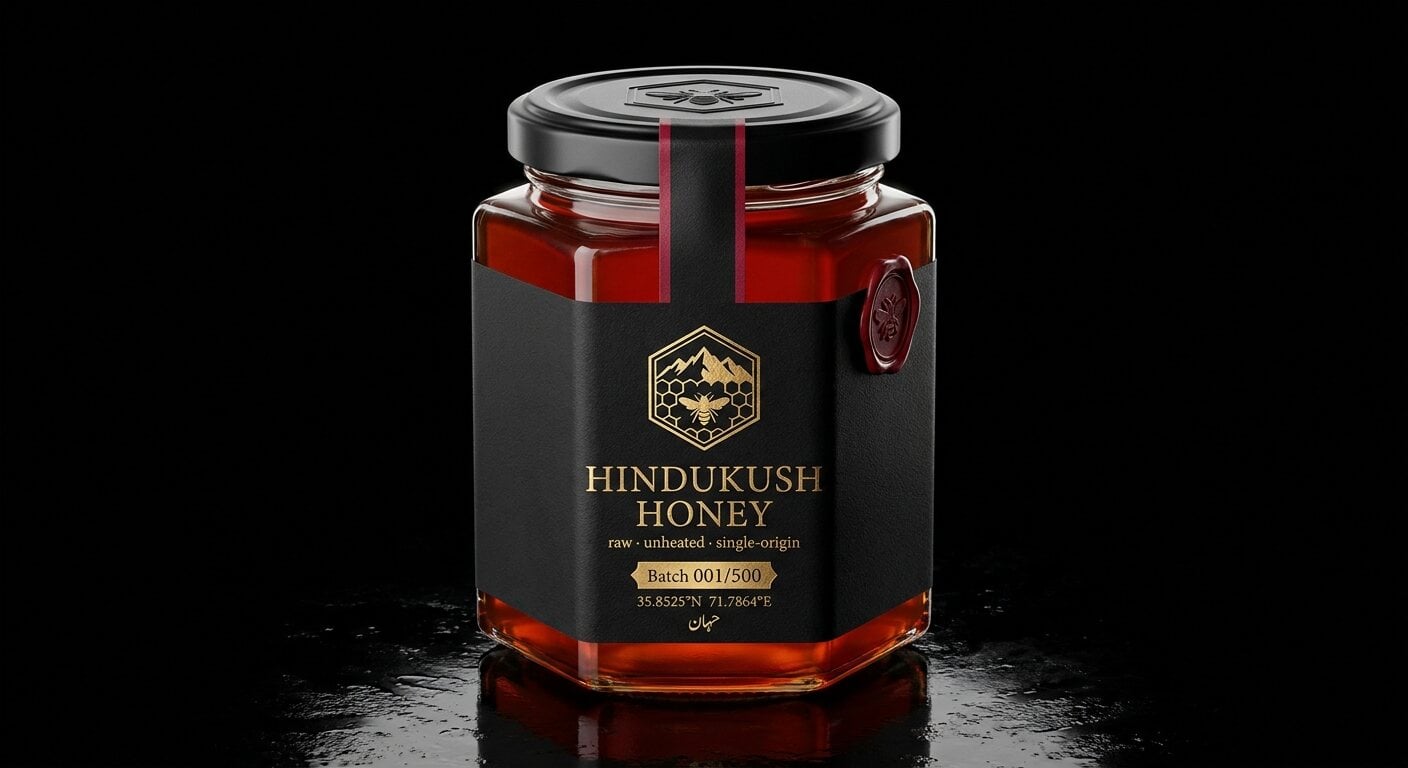
The full Hindukush Honey lineup — five hexagonal jars, one per valley, black labels with gold foil
The full index — Zaytoon, Acacia, Sanaf, Tumberi, Wild Berry. Five valleys, five batches, one house.

03 — The Jar

Read the label.
It reads back.

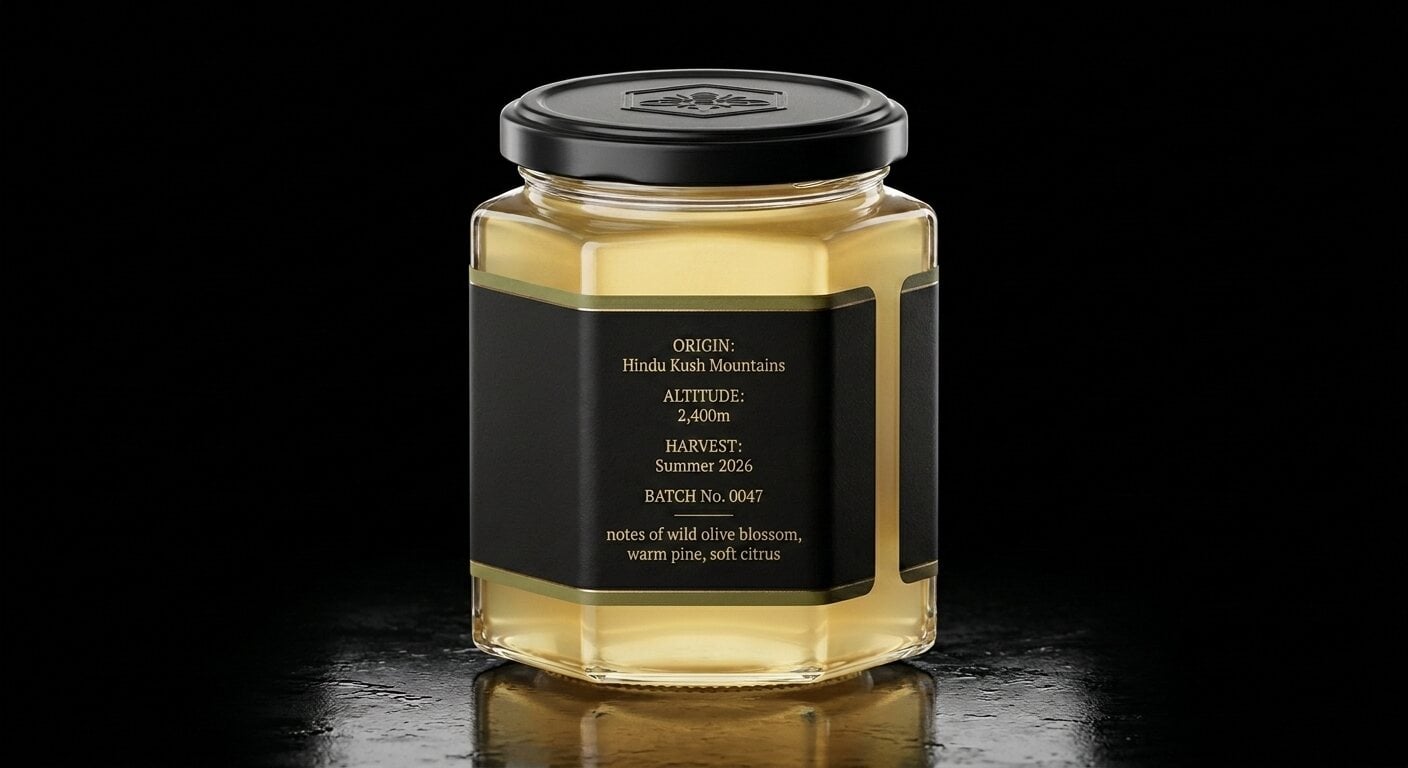
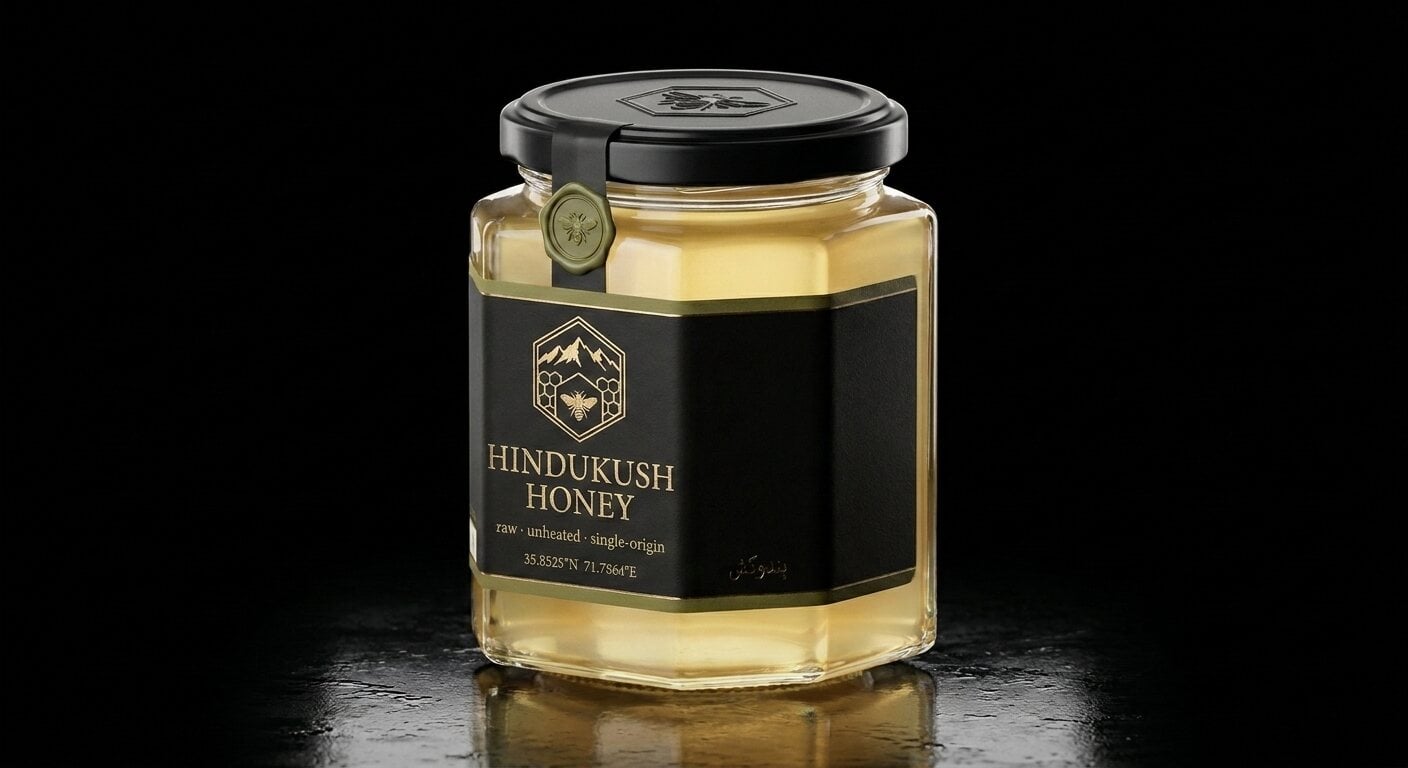
Scroll — the jar turns. Front carries the emblem and the variety; the back carries the valley, the altitude, the window, the batch.

Zaytoon jar — front label, emblem and variety
Zaytoon jar — back label, origin and batch

Front label — emblem & variety

Zaytoon jar — three-quarter view
Three-quarter
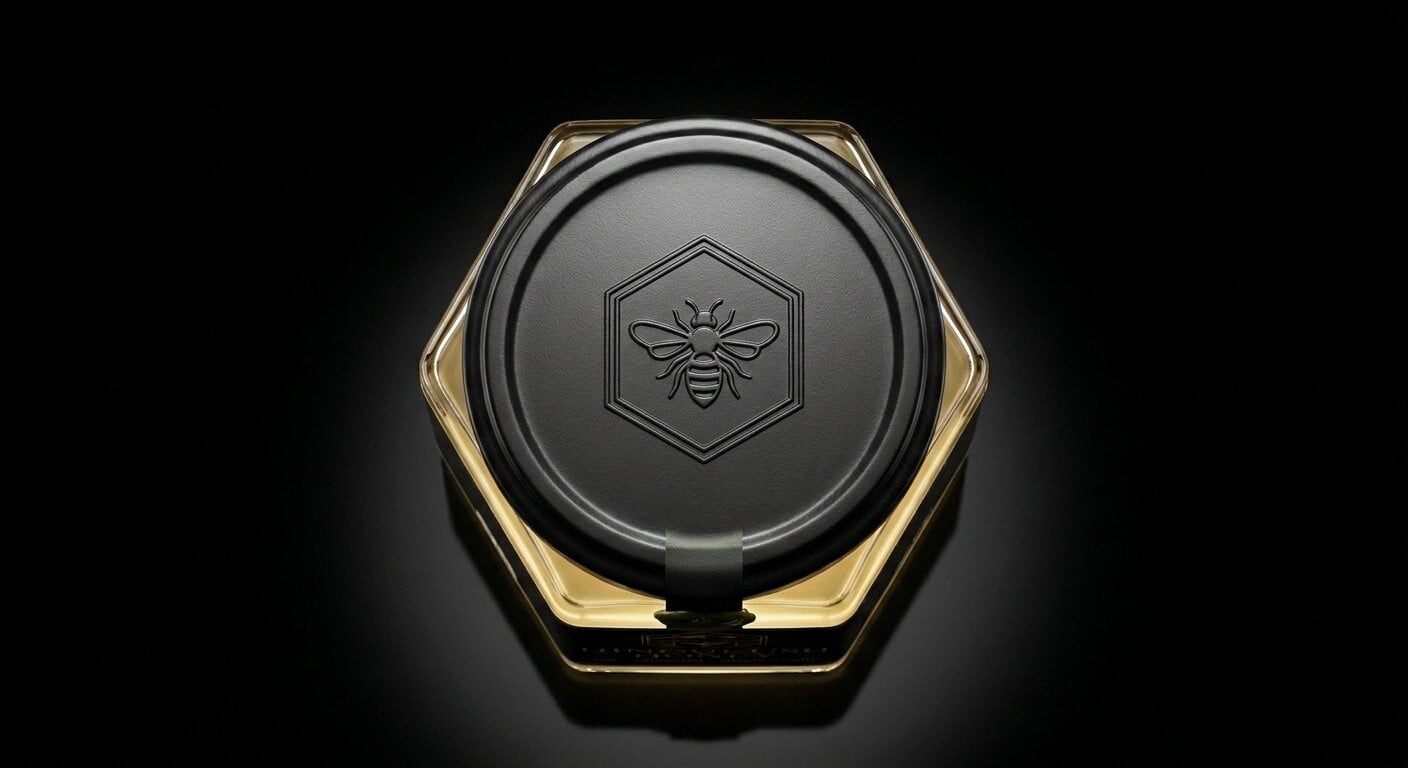
Zaytoon jar — top down view
Top down
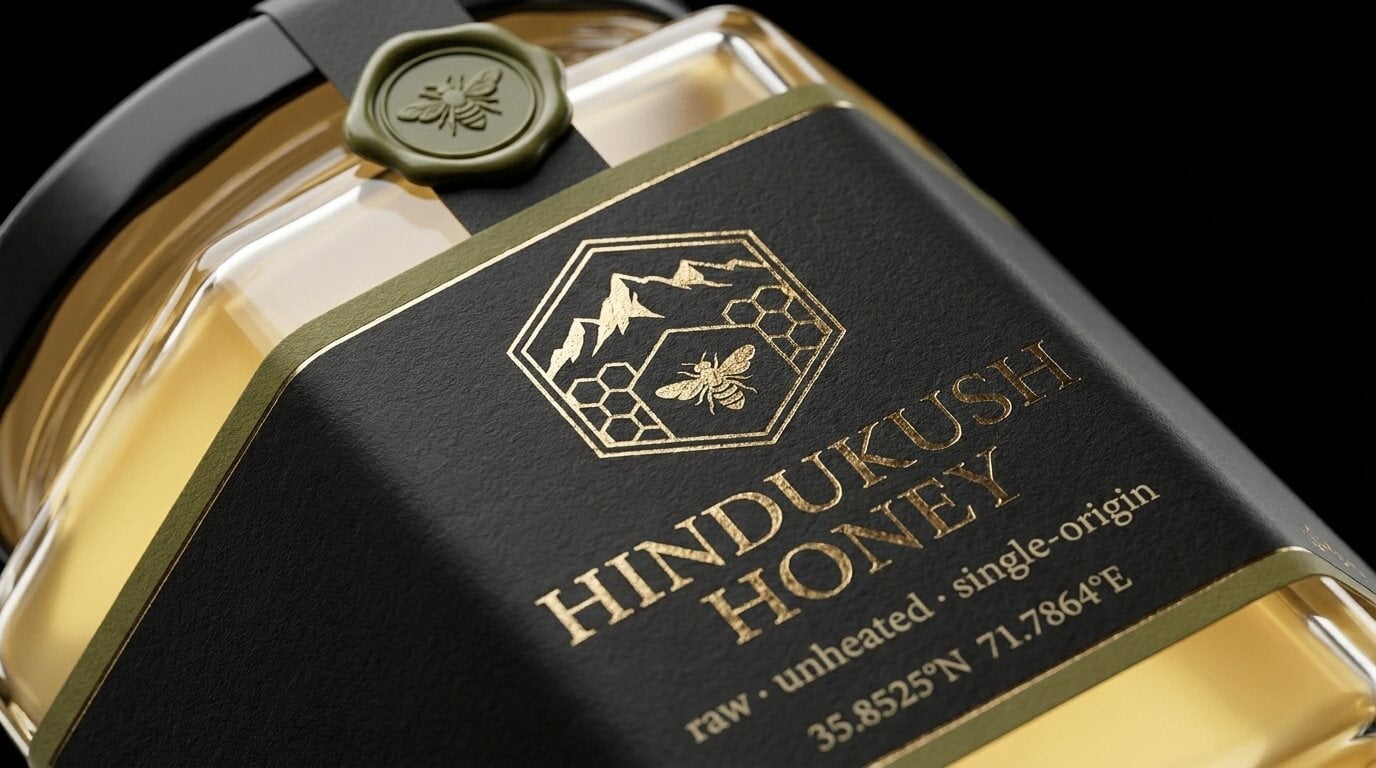
Zaytoon jar — macro view
Macro

Wax seal

Beeswax from the same hives, pressed by hand. Brittle in winter, soft in summer — it tells you the room's temperature.

Neck band

Carries the source in two scripts — Latin and Nastaliq — and the variety's colour chip.

Front label

The emblem, the name, the valley. Printed on unbleached kraft; it will spot and age like a field notebook.

Back label

Origin, altitude, bloom window, hand-numbered batch, tasting notes, and the coordinates. Nothing hidden.

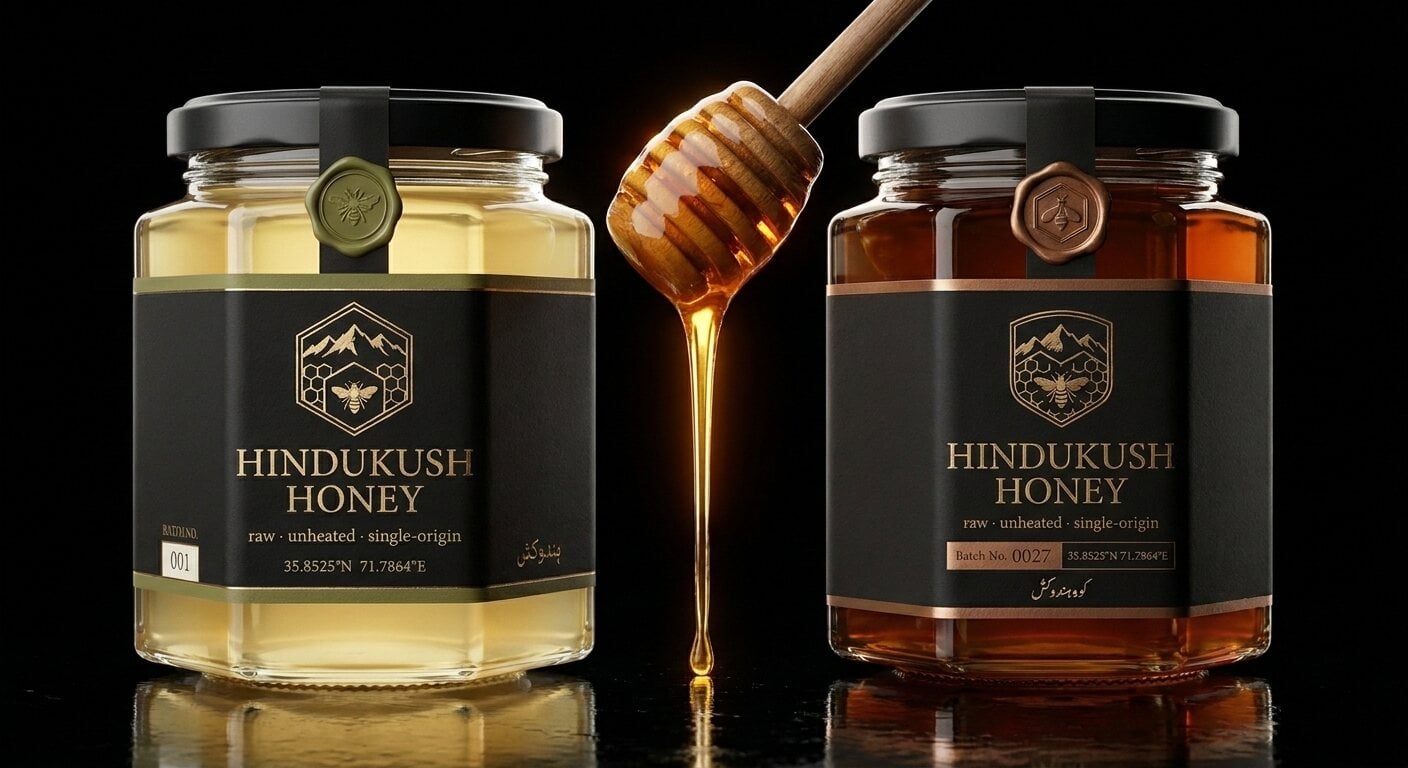
Two hexagonal jars of Hindukush Honey staged together, black and gold labels
The hero duo — black glass, gold foil, valley light.
The five varieties of Hindukush Honey in a staggered studio arrangement
Five valleys, staggered. No two batches alike.
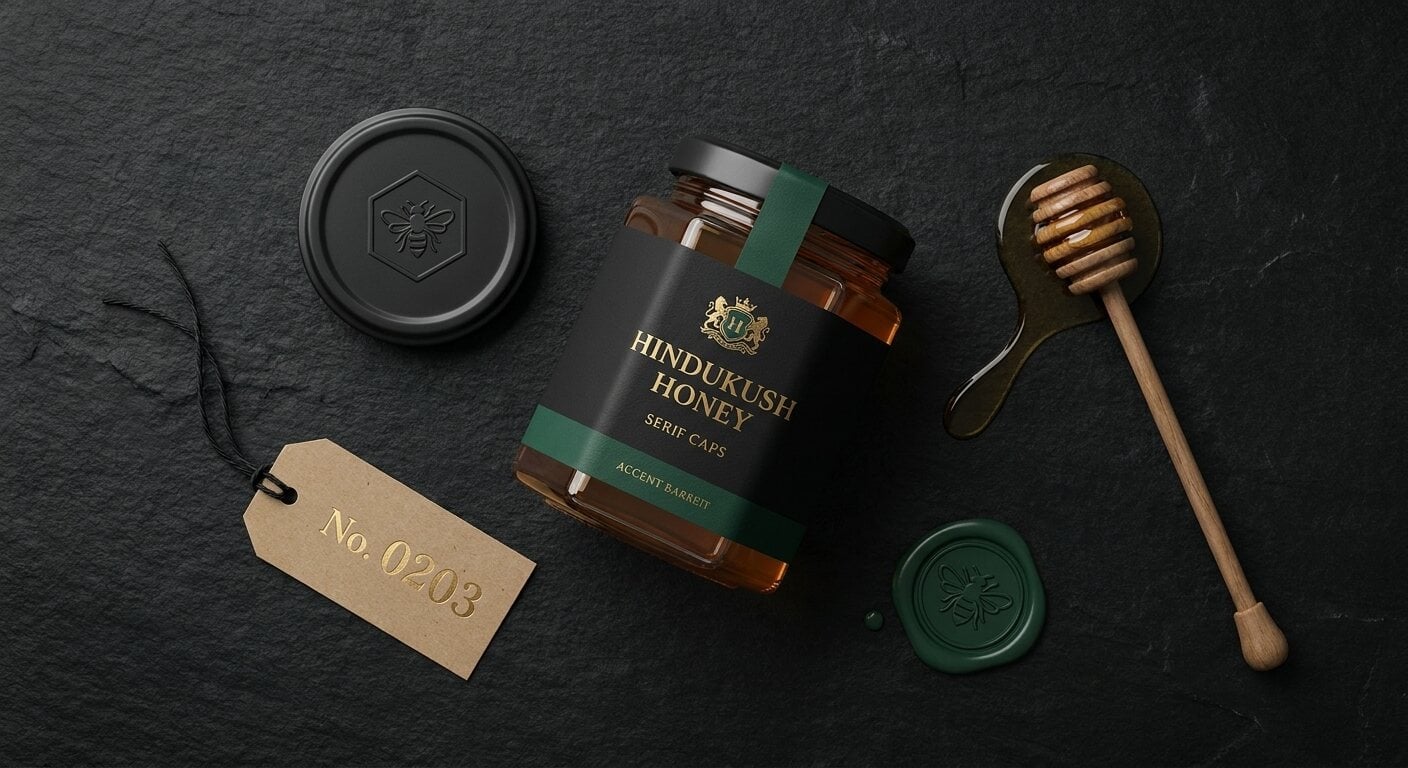
Flat lay of Hindukush Honey jars with packaging
The full ritual — jar, box, seal, batch card.

04 — Purity & Lab Testing

Proof, not
promises.

Every batch goes to an independent lab in Islamabad before it ships. The certificate ships with the jar; the numbers live next to the batch number, where they belong.

Sealed under wax
EST. 1987 · CHITRAL

HMF

< 12 mg/kg

Hydroxymethylfurfural — the heat marker. Ours reads like it never saw warmth, because it didn't.

Diastase

> 11 DN

Enzyme activity. Live honey breathes; this is its pulse, well above the Codex floor of 8.

Moisture

< 17.5%

Low water means the bees capped it when it was ready, not when we were impatient.

Pollen analysis

Single valley

Melissopalynology on every batch. If the pollen says two valleys, it doesn't ship.

C4 sugars

0.0%

No cane, no corn, no syrup of any kind. Tested per batch, published with the batch number.

Certificates of analysis available on request for every batch since 2019. Crystallisation is natural and expected in raw honey — it reverses in warm water, never in a microwave.

05 — The Beekeeping

Slow by
necessity.

There are no shortcuts at 3,000 metres — only the long way, done carefully, in the right week of the year.

  1. 01

    The climb

    Apiaries sit a day's walk above the last road. Boxes are carried up in March, before the snow lets go of the passes.

  2. 02

    The wait

    No feeding, no smoke unless the colony turns. The bees work the bloom; we watch the weather and say little.

  3. 03

    The pull

    Frames are pulled at dawn, capped comb only. Each frame is cut by hand and crushed within the hour — never spun hot.

  4. 04

    The rest

    Honey settles for nine days in steel, cold valley air doing the work of filters. Nothing under 200 microns is removed.

  5. 05

    The seal

    Jars are filled, weighed, and sealed in beeswax. The batch tag is numbered by hand. Then the jar waits for you.

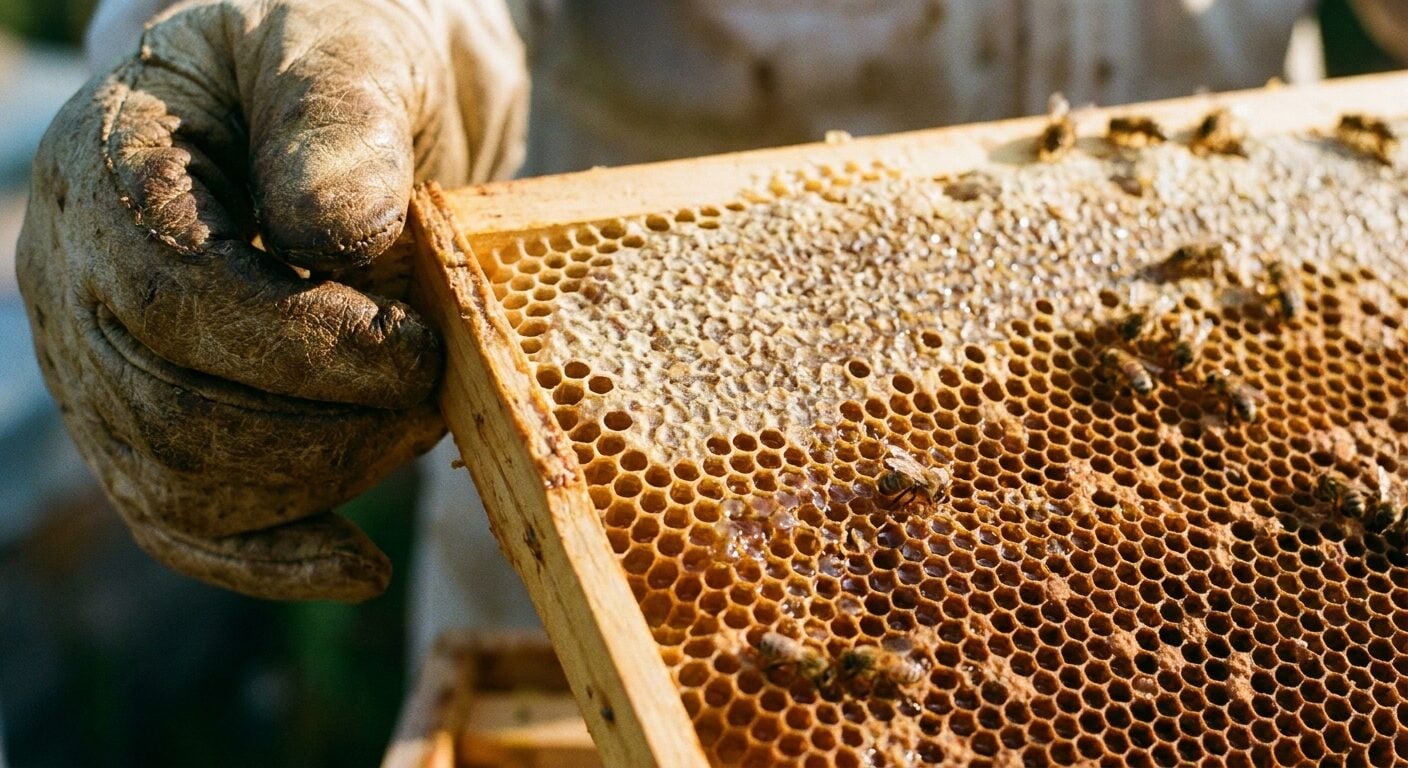
A beekeeper's gloved hands holding a frame of capped honeycomb

Capped comb only. If the bees haven't sealed it, it isn't ready — and it stays.

06 — Story & Beekeepers

Three
generations
of waiting.

Sher Wali's grandfather kept log hives in the apricot trees above Drosh before the valley had a jeep track. His son moved the colonies into frame hives and started numbering the batches in 1987. Sher Wali's daughter now runs the lab paperwork. The method has not changed; the record-keeping has.

Every keeper who works with us owns a share of the harvest price, not a wage per kilo. When the bloom fails, we all earn less. When it sings, we all earn more. That is the whole arrangement, and it has held for three generations.

پہاڑ فیصلہ کرتا ہے

Sher Wali Khan beside log hives on a terraced Chitral hillside

Sher Wali Khan, Drosh apiary band, April. Log hives older than the road below.

The bees were here before the road. We are guests with jars.

Sher Wali Khan

Master beekeeper, Drosh · 38 seasons

A seal is a promise you can break only once.

Bibi Zainab

Wax & seal, Chitral town · 21 seasons

Thyme opens when the snow lets go. You don't rush the snow.

Fazal Rahman

High apiaries, Shandur · 17 seasons

07 — From the table

Empty jars, kept on shelves.

The Zaytoon jar is the first honey I've tasted that argues back. Fig, then olive leaf, then a long peppery finish that stays for minutes.

Amna R.

Lahore — Batch HK-24-ZT-041

I've bought mountain honey in three countries. This is the first one where the jar tells you the coordinates and actually tastes like the map.

Jonas K.

Copenhagen — Batch HK-24-TM-003

Opened the acacia for tea. Finished it with a spoon, standing at the counter, in four days. Ordered three more before writing this.

Sara M.

Dubai — Batch HK-24-AC-017

The wax seal, the hand-numbered tag, the contour lines on the box — my father kept the empty jar on his shelf. That says everything.

Bilal H.

Islamabad — Batch HK-24-SN-008

08 — The Shop

Reserve your
batch.

Jars are 227 g, wax-sealed, shipped in a kraft gift box with the batch certificate. When a batch is gone, the number retires.

Zaytoon — hexagonal jar of Hindukush Honey, black label with gold foil

Zaytoon

Drosh Valley · HK-24-ZT-041

black fig · olive leaf · warm tobacco · long pepper finish

$38

Acacia — hexagonal jar of Hindukush Honey, black label with gold foil

Acacia

Bumburet, Kalash Valleys · HK-24-AC-017

white flowers · vanilla pod · green apple skin · clean finish

$34

Sanaf — hexagonal jar of Hindukush Honey, black label with gold foil

Sanaf

Mastuj River Banks · HK-24-SN-008

apricot jam · rose water · sea salt · warm crumb

$36

Tumberi — hexagonal jar of Hindukush Honey, black label with gold foil

Tumberi

Shandur Plateau · HK-24-TM-003

wild thyme · pine resin · dark caramel · menthol breath

$42

Wild Berry — hexagonal jar of Hindukush Honey, black label with gold foil

Wild Berry

Garam Chashma · HK-24-BR-029

sour cherry · barberry · cocoa nib · bright acid line

$36

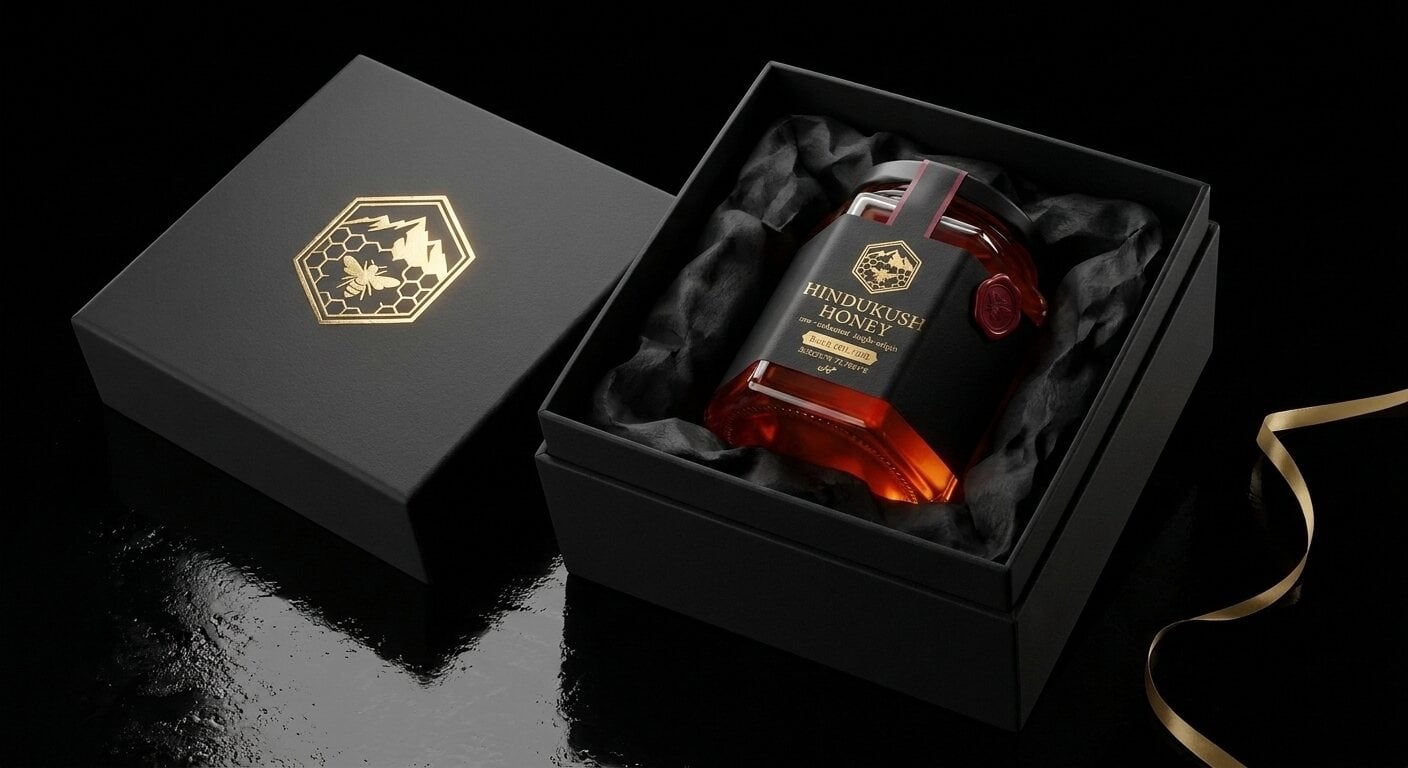
Hindukush Honey gift box — jar nestled in black packaging with gold accents

The gift box

A valley, boxed.

One jar, a hand-dipped beeswax candle from the same comb, a carved deodar dipper, and the batch card with its coordinates. Wrapped in kraft, tied with twine, stamped with the seal. $59, any variety, any batch still open.